

Key Summary
- Headcount can add capacity, but healthcare operations only improve when the work is organized, visible, owned, and consistently executed.
- A daily operating rhythm helps leaders track volume, turnaround times, priorities, escalations, and quality before issues affect patients, providers, or revenue cycle work.
- Clear ownership prevents missed handoffs, duplicated work, delayed follow-ups, and inconsistent performance across healthcare support workflows.
- Scalable healthcare teams need documented processes, role-specific training, quality standards, coaching, and feedback loops to maintain control as volume grows.
In healthcare operations, pressure is constant. Teams are being asked to move faster, reduce backlogs, support patients and providers, manage documentation, and keep revenue cycle work moving. I have seen how quickly that pressure can build when the volume increases but the structure around the work does not keep up.
The first response is often to add more people. I understand why. More people can help create capacity. But in my experience, headcount alone does not solve the real problem if the operation does not have rhythm.
Strong healthcare operations management is about making sure the work is organized, visible, owned, and consistently executed. Because when the workflow is unclear, adding more people can create more activity without creating better results.
Why Headcount Alone Does Not Solve Operational Gaps
When healthcare teams are under pressure, staffing is usually the first thing leaders look at. As Warren Ratley, Connext’s VP for Healthcare Services, said, the challenge goes beyond clinical roles. It also shows up in eligibility checks, claims follow-up, prior authorization, documentation, billing support, scheduling, patient coordination, and reporting.
You can have people in place and still deal with delayed follow-ups, unclear priorities, missed handoffs, and inconsistent quality. That usually happens when the process is not clear enough or when healthcare operations management is too reactive.
I have seen teams work hard every day and still struggle because the basics are not fully defined.
- Who owns the task?
- Who follows up?
- Who checks the work?
- Who escalates the issue?
- Who confirms completion?
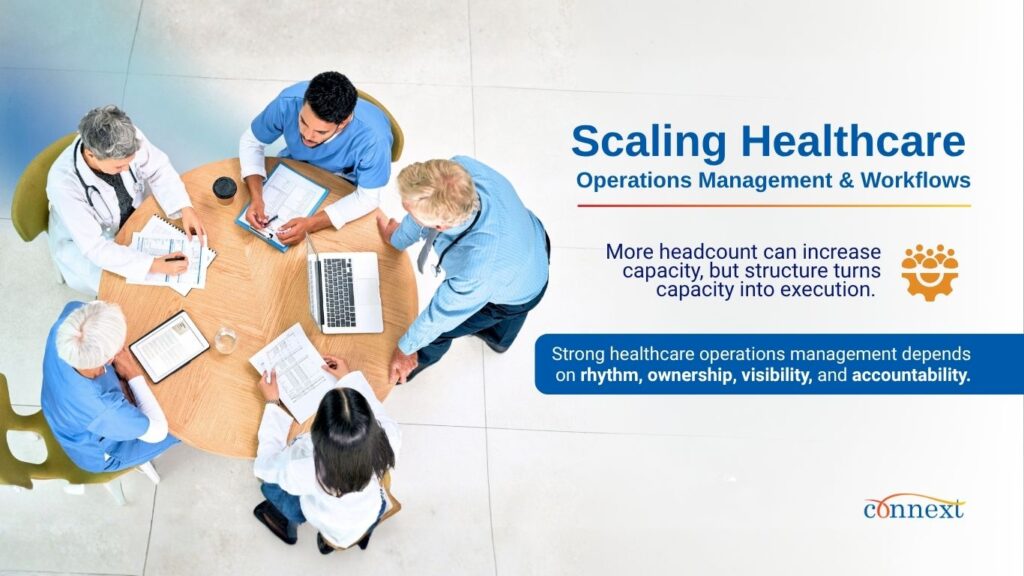
If those answers are unclear, performance becomes inconsistent. In healthcare operations, small gaps can create bigger issues. A missed eligibility check, delayed prior authorization, incomplete claim follow-up, or documentation error can affect scheduling, patient access, reimbursement, and downstream work. More headcount can increase capacity, but structure turns capacity into execution.
The Importance of Daily Operating Rhythm
Healthcare operations need rhythm. A strong daily operating rhythm gives teams a way to stay aligned. It helps leaders see what is moving, what is delayed, and where support is needed. It also keeps small issues from becoming larger problems.
For me, this is where healthcare operations management becomes very practical. It shows up in things like:
- Daily huddles: Short check-ins help healthcare support teams align on priority cases, urgent patient access issues, pending authorizations, claim delays, and documentation needs.
- Volume tracking: Leaders need to know how much work is coming in, how much is being completed, and where backlogs are building across scheduling, eligibility, billing, claims, and patient coordination.
- Turnaround time monitoring: Claims follow-up, prior authorization, documentation review, scheduling support, and patient coordination all depend on timely action.
- Escalation paths: Teams should know when to escalate a delayed authorization, denied claim, incomplete documentation, patient access issue, or provider request.
- Quality checks: Regular review helps catch billing errors, documentation gaps, authorization issues, and process misses before they affect patients, providers, or reimbursement.
This is the kind of rhythm that keeps healthcare operations steady. Without it, leaders end up reacting after the issue has already affected the patient, provider, or revenue cycle. With it, teams can manage the work with more visibility and control.
Clear Ownership Improves Healthcare Support Workflows
Healthcare support work has many moving parts, from eligibility checks, claims follow-up, and prior authorization to documentation review, billing support, patient coordination, provider communication, and reporting.
Prior authorization is a good example of where clear ownership matters. Tasks like sending authorization requests, following up on eligibility questions, generating authorizations, and tracking expired specialty authorizations need to be assigned clearly.
When these tasks are delegated to a dedicated healthcare support team, the process becomes more efficient, claims are supported more accurately, and in-house staff can stay focused on patient care.
When ownership is unclear, work slows down. Tasks get duplicated. Follow-ups are missed. Escalations happen late. And the team becomes harder to manage.
Training and Process Consistency Keep Teams Scalable
Healthcare support work cannot rely only on individual experience. It needs clear training, documented workflows, and consistent standards.
One of the 2026 healthcare trends is that training is moving away from generic, check-the-box learning and toward role-based, data-driven workforce development that connects directly to daily responsibilities. For healthcare support teams, that means training should be specific to the work people actually handle, such as eligibility verification, prior authorization, claims follow-up, billing support, scheduling, documentation review, and patient coordination.
When processes live only in someone’s head, the operation becomes harder to scale. New team members take longer to ramp up. Quality becomes inconsistent. Leaders spend more time correcting mistakes instead of improving the workflow.
This is especially important as prior authorization and revenue cycle workflows become more time-sensitive. CMS requirements create tighter expectations around prior authorization turnaround times, denial reason documentation, and public reporting of certain prior authorization metrics. That raises the need for teams to follow clear workflows, document actions properly, and escalate issues on time.
Strong teams need:
- Clear process documentation
- Defined quality standards
- Role-specific training
- Regular coaching
- Ongoing feedback loops
When training is consistent, teams can grow without losing control. That is what allows healthcare organizations to scale support work while protecting quality, turnaround time, and accountability.
How Offshore Healthcare Teams Support Better Execution
Offshore healthcare teams can add real value when they are built the right way. The value is in building a team that is aligned with the client’s workflows, systems, standards, and expectations.
An offshore healthcare team can support high-volume work such as:
- Eligibility verification
- Claims follow-up
- Prior authorization support
- Patient scheduling support
- Billing and coding support
- Documentation review
- Payment posting
- Denial management support
- Patient and provider coordination
- Reporting and administrative support
Structure matters. Offshore teams should be embedded into each assigned workflow, trained on specific task requirements, measured against clear standards, and supported with the right management rhythm. That is how offshore support becomes part of stronger healthcare operations management.
At Connext, this is how we think about healthcare support. We are not just helping organizations add capacity. We are helping them build dedicated teams with structure, visibility, and accountability.
A vision clinic holding company partnered with Connext to build a multilingual patient scheduling team that improved patient access, reduced wait times, and strengthened overall service delivery. The case study highlights how strategic recruitment, training, and process optimization helped create a scalable scheduling function that supports a diverse patient base while improving operational efficiency and patient satisfaction.
Final Takeaway
In healthcare operations, capacity only creates value when it is supported by rhythm, structure, and accountability. More people can help reduce pressure, but headcount alone will not fix unclear workflows, inconsistent follow-up, or limited visibility.
That is why healthcare operations management has to focus on more than staffing. It has to focus on how the work moves every day, who owns each step, and how teams stay aligned. Healthcare teams need a rhythm that keeps the operation moving.
Ready to build and manage a high-performing team in the Philippines?
Schedule a free workforce consultation with a Connext specialist.
Visit connextglobal.com/contact/ or email mailto:sales@connextglobal.com
Like what you’re reading?
Add Connext as a preferred source on Google — it only takes a moment and helps more professionals find our content.




You're done. Thank you!